

The Transparency Act, which was adopted on 1 July 2022, aims to ensure respect for fundamental human rights and decent working conditions. It also provides transparency and full insight into how major companies work to promote this.
The law imposes a duty of disclosure and due diligence. Our efforts to introduce the Transparency Act will be part of our long-term strategy to strengthen our work on sustainability and decent work.
1. Purpose of the programme
The procedure shall help to ensure that our operations and our co-operation with suppliers promote the purpose of the Transparency Act. This means respecting fundamental human rights and decent labour conditions in connection with the production of goods and provision of services. It involves ensuring that the general public has access to information about how companies deal with negative consequences for fundamental human rights and decent working conditions.
The procedure is intended to ensure that our business fulfils the requirement to carry out and report on due diligence assessments, as well as complying with the information obligation in the Transparency Act. This is in line with UN Sustainable Development Goals number 8 and number 12.
2. Scope
The procedure includes risk assessments and due diligence related to business relationships and direct and indirect purchases in our business. The due diligence assessment is based on a risk-based approach. The law applies to companies and suppliers that fulfil two of the following conditions:
- Sales revenue: NOK 70 million.
- Balance sheet total: NOK 35 million.
- Average 50 employees during the financial year.
3. Responsibility
The Board is responsible for defining the scope of the due diligence. The CEO has overall responsibility for compliance with the procedure and, in consultation with the management team, must ensure that due diligence assessments are carried out in the various parts of the company's business areas.
4. Description.
Due diligence must be carried out in accordance with our risk assessment model, which is included in the quality system based on OECD guidelines:
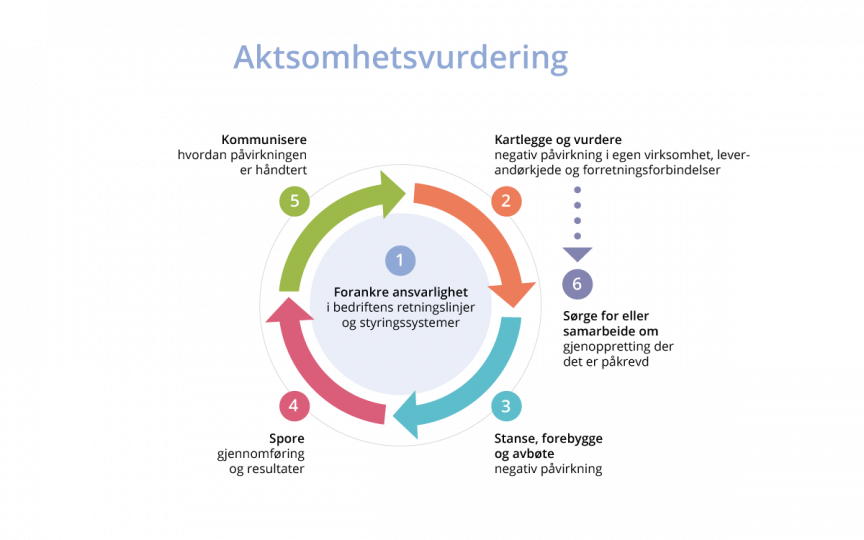
5. Carrying out risk assessments and due diligence
Risk assessments must be carried out according to the following work methodology:
- A due diligence assessment will be carried out based on our stakeholder analysis (ISO 9001), where we map the risk of negative consequences for basic human rights and decent working conditions. This will be carried out by the QAHMS manager in co-operation with the general manager of the Tratec companies.
- Working meetings for reviewing due diligence assessments of suppliers must be held at least once a year. The QAHMS manager plans the meetings and ensures that those responsible in the companies participate. The working meeting includes a review of the due diligence related to our procurement of goods and services. We will obtain information about suppliers' value chains and map risk areas related to industry, location, possible negative effects and damage, previously registered deviations - and assess whether we contribute, cause or are directly associated with negative consequences.
- Based on the results of the due diligence assessment, areas for improvement and measures will be decided, and prioritised measures will be initiated if necessary. We use a separate form for obtaining information from suppliers and business partners.
- Measures will be implemented directly towards suppliers/wholesalers from our business or through a joint enquiry from the industry through a trade association or other partners.
- The result of the due diligence is documented in a written report. The written report from our due diligence is prepared in accordance with the Transparency Act and is available on our website.
- In line with the Transparency Act, we state in the annual report where the report is available, and update and publish the report by 30 June each year.
Changes:
If our business in a purchasing area becomes aware that there may be significant changes in the supply chain, those responsible in the company must follow this up and, if necessary, ensure the revision of due diligence assessments and document this in a written report.
6. Deviation
In the event of a suspected breach of contractual obligations related to the Transparency Act, deviations must be reported to the responsible manager and registered in our quality system. The system is set up with a separate case category for registration of such incidents. All incidents related to such deviations must be categorised as high severity and follow our procedure for case management and cause analysis.
7. Statement of due diligence on our website
All companies in Tratec must annually provide an account of the due diligence performed. This must be general and include the most important aspects. The report will be available on our website.
The report will include the following information:
- General description of how the business is organised and its area of operation. Relevant industries, markets, products and services for the business.
- Description of policies and procedures.
- Report on actual negative conditions that have been uncovered, if any.
- Possible negative conditions with materiality risk that have been uncovered.
- Description of measures taken to stop or limit the aforementioned conditions.
It is the board of directors that signs the report. Section 5 of the Transparency Act requires the Board of Directors and CEO to sign the organisation's report on due diligence. The report must be updated and published by 30 June each year, and otherwise in the event of significant changes in the organisation's risk assessments.
8. processing of information requests
In accordance with the Transparency Act, everyone has the right, upon written request, to information about how our business handles actual and potential negative consequences related to human rights and decent working conditions in our supply chains. This includes both general information and information related to a specific product or service offered by the organisation.
All enquiries regarding information requirements must be sent in writing to the general manager of the Tratec company to which the request is addressed. The deadline for response is 3 weeks.
Requests do not trigger an obligation to take action, but may lead to the discovery of risks that should be addressed. In principle, the organisation can refer to due diligence, but there may be a need to obtain information. The scope of the information must be proportionate to the use of resources.
Information requests can be denied if the request:
- Is not clear and relates to immaterial information.
- Applies to information about competitive conditions (production methods, strategy, etc.).
- Is unreasonable (harassing, requires disproportionate resources, etc.).
- Applies to personal circumstances (characteristics, health status, beliefs, etc.).
Explanation of the due diligence in Tratec
Explanation of Risk Assessment for Tratec Teknikken
 Norwegian
 English